Friday, September 12, 2014

7 Things I Learned from Writing a Novel in Three Months

I've been absent, dear readers, and for that I apologize. It's been a full summer: in the last three months I graduated college, started work full time, got married, and wrote a book.

I stocked up on Who gifs, too.
Let me explain—no, there is too much. Let me sum up.

In April I was chosen as a finalist in this contest, which meant I needed to finish a book by September 1. Said book was about 50 pages long and needed at least 450 more. But with school, graduation, and life in general swallowing most of my free time, I didn't really start work on it until late May (because life after college is definitely less busy, right?).

And after a mean season, that book is done. It's 160,000 words/800 pages long, and I made it in less than 100 days.
Pardon the dramatizing. I feel entitled to a bit of histrionic.
So if this post feels a little bit, erm, self-congratulatory, I apologize. I do feel like I did a cool thing. But I will try not to act like I did The Coolest Thing.

Anyway, there's a longstanding human tradition of sending an expendable scout to find out how things look in an unfamiliar area. And somehow I don't think everyone reading this blog wants to do NaNoWriMo for three solid months.
Blood. Sweat. Tears. Red ink. Wrist cramps. Still tears.
So here's the lay of the land.


1. Inspiration will not do the work.

Those arms are not designed for heavy lifting.

I used to think Inspiration came to those who wait, cause you can't rush art, and all that. The Muses are unpredictable, willful creatures. And everybody knows that if you chase a girl, she runs.

Stephen King disagrees. In his estimation, the Muse is a gruff, surly dude who lives in the basement and demands that you do all the work. The Muse thinks you're a cocky punk. He's got a bag of magic, but you won't even glimpse it until you prove you're not wasting his time.


2. "I'm too busy" Is. Not. Valid.

This is basically a Buzzfeed list.

I spent a whole bunch of years "too busy" to write. The urgent tasks taking up my time: Netflix, imgur, and Facebook, mostly. I didn't need more time—even when I got it, I mostly flushed it online.

A teacher told me once that we almost never have time problems: we have time distribution problems. Maybe you have an absurdly exhausting, no-time-to-spare life; I wouldn't know.

What I do know is my own experience: between forty hours a week at the office, shopping for groceries, researching insurance agencies, moving into an apartment, figuring out a budget, registering the car, doing laundry, washing dishes, paying rent and utilities, and spending time with my wife, there was still time to write. It meant getting up at 5:30 every day. It meant writing during lunch. It meant not finding out what lunch items my peers had taken pictures of, postponing the Netflix queue, and refusing to self-anesthetize with pictures of cats. (Stunningly, the Internet did not vanish during my absence.)

Note: our apartment has no wifi, and writing there was far easier than writing at Starbucks.

3. Sacrifice free time, not family time.


There's exactly one thing I regret from this whole adventure: how poorly I treated my wife.

Not by being angry or snappish or impatient. Just absent. Nobody wants to share their spouse with a computer for the first two months of marriage. (Not for any months of marriage, I think.)

It took me a month and a half to figure out how much I was hurting her, because I am One Oblivious Dude. Take it from me: a dream that steals you completely away from the most important people in your life gets poisonous right quick.

4. Write. Every. Day.

I've never seen anyone do this after running. Ever.
When I felt like I'd earned it—usually after a day when I'd written a whole lot—I'd take "break" days to rest.

Exceptionally bad idea.

One break day turned into two, two turned into three, and when I got back to the manuscript I had to spend an hour just picking up speed. Momentum is the best advantage you can have in this first draft stage, I think; it's the only thing that got me over the hump.

Note: If I had this to do over again (and had a bit more leeway), there'd be one planned break day per week—not one or two break days when I felt like I needed it.

5. Perfect manuscripts don't get submitted.

This, but with sentences and periods and characters and
DANG IT JUST START THE BOOK OVER
I've self-identified as a writer for nearly 15 years and, in that time, have finished exactly two large-scale projects. Two. *

I suffer from a rare absurdly common affliction called perfectionism. Most of my writing projects lasted for about three chapters before I hit hard reset.

The truth is, I hate editing my own work with a powerful hate. I reasoned that if it wasn't perfect at the beginning, the errors would only pile up and by the end the manuscript would be a mess. Then I'd just have to spend more time editing.

Here's the deal, though.
  1. Perfect first drafts don't exist. Perfect manuscripts don't exist.
  2. While I'm tinkering, thumb-twiddling, and bemoaning the writing life like I've got nothing better to do (cf. #6 on this list), the deadlines have come and gone.
My work is never going to be as good as I want it to be, and that's okay, and obsessing over imperfection in a first draft is a poor excuse to leave so much unfinished.

Note: I don't want to communicate that writing very little is inherently shameful. Quite a few excellent authors like to take their time (Patrick Rothfuss's first draft took seven years, his revision another seven; Steven James rarely writes more than 120 words in an hour). My issue is that I had so much available time and energy and I did so little with it. 

6. We're afraid of finishing.

My face for the last three months.
Seth Godin calls it the lizard brain. It's the part of you that doesn't want to stand out from the crowd. The part that starts freaking right the heck out when the deadline comes close. The part that is deathly afraid of failure.

If you finish, you might submit, and if you submit then people could read it, and if they read it they might not like it, and if they don't like it then the townsfolk will riot and they'll beat down your door and come at you with pitchforks and torches and then the world will explode and EVERYONE WILL DIE.

It might not escalate quite that hugely, but the feeling is...kinda the same. It's not just writers who get nervous about people seeing their stuff. We're all afraid of failure. We hate failing more than we hate anything else.

7. Finish things anyway.
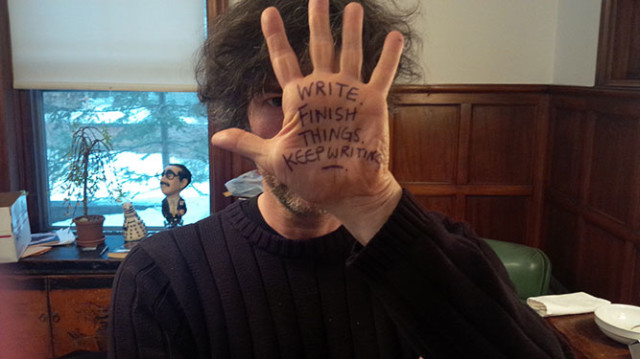
This is Neil, and he is right.
Where creative work is concerned, nothing matters like finishing. Finishing is how we beat the lizard brain. The more we finish, the more we see that the villagers won't burn us alive for finishing.

So finish. Finish regularly. Finish something huge, something you're afraid of finishing. Your lizard will protest, and you'll want to stop and edit and revise and maybe start over. Finish.

After four years of college-level writing education, those five words on Gaiman's hand are still the best writing advice I've ever seen.

Real Messes vs. Imaginary Masterpieces

The projects in our heads will always always always be better than what we make. There's friction between our dreaming and our forming; our real work will always be too heavy, too thick.

That sounds awful; in truth, it's freeing.

This summer, more than anything, I learned the value of real. The book I submitted is flawed (hugely, embarrassingly, unbearably flawed). But the flaws in something real can be mended. The flaws in something imagined can't even be seen.

And this is very, very real. 

Thursday, June 12, 2014

The Round Robin Blog Tour: An Excuse to Soliloquize on Myself

Sarah Sawicki, blogger, wrote a story once that made me feel really slimy, but she hasn't repeated the practice since. Our most recent interaction involved her tagging me to participate in the Round Robin Blogging Tour, where I talk about myself and then talk about bloggers I think are cool (and who will be tagged so that they can do as I'm doing). Skip to the bottom if you've heard enough about me by this point.

1. What are you working on?

A massive, brain-eating project that I might die trying to complete. Here's the deal: I'm a finalist in this competition for Simon451, the new speculative fiction imprint from Simon and Schuster. The original entry was a book summary and 50 pages of that book, which I killed myself completing just because I thought it was worth it. The problem was that I got in...and now I have to write a book by September 1. Yes, I know, I'm whining about being showered in gold, but this is still a daunting prospect because I am now tasked with turning 50 pages into about 300 before September starts (or before August if I want to edit it at all).

The project itself is a familiar one, a fantasy story called Ashes, which some of you may have read. It is positively troperrific. Check this out:

In a city where everyone hides their faces behind masks made of light, a clever young beggar-thief with a fierce protective instinct severely pisses off a lot of powerful people in the course of staying alive. He attracts the attention of an illusionist who teaches him a magic system based on bald-faced deceit. Life gets even more complicated when they discover a way they and their fellow magicians can make their illusions real—and encounter a silent, grim-faced creature working to kill them before that happens.

If it helps at all, it's Oliver Twist mashed up with Harry Potter in Atlantis, sprinkled with bits of Treasure Island and Jack the Ripper, and the protagonist is the Tenth Doctor as a teenager (so Aladdin, but somewhat cleverer). And the magic system is Polyjuice Potion on steroids, which is great fun to play with (and resembles my original drafts not one single bit. Well, maybe one single bit).

Also I'm getting married (!!!) in nine days (!!!!!) to a beautiful, thoughtful, extremely smart and goofy lady. She doesn't blog much, but she put some thoughts down a little bit last summer. Click to read.

And, just to add things on, I started working with the Christian Writers Guild about three days after graduating. I edit things, sometimes I write things, but mostly I get paid to have a blast with a bunch of smart, entertaining folks for eight hours a day.

So...it's going to be a busy summer.

2. How does your work differ from others in its genre?

Mostly that it's less informed and more self-conscious. I tend to write fantasy, which is famous for two things: Tolkien and knockoffs. However, that's been changing, what with giants like Pratchett, Gaiman, Rothfuss, and Sanderson in the field. The fantasy that's genuinely worth reading is marvelous, and I write in the desperate hope that someday I can ape it in a worthwhile fashion.

If we limited my genre from fantasy to lower-tier fantasy, my work currently differs from those in its genre by virtue of its profound lack of dragons or anything remotely dragon-related. Or hobbit-related. And no orcs, either. Still pretty unabashedly British, though. I can't make my characters speak like real Americans, which is a problem since I've heard so few British people actually speak.

3. Why do you write what you do?

Mostly? Because I think I'm good at it, and I enjoy doing it.

When I started writing it was mostly an excuse not to do chores. Or...well, I suppose that's not entirely true. When I started writing it was not for any purpose that I could have articulated. The first things I wrote—really wrote, mind, not for anyone else's purpose but my own—were recollections from TV shows.1 I scrawled them in a notebook,2 trying to remember every word, and drawing pictures to match.3 I don't recall doing it because I wanted to write books, or because I wanted to show off. If anything, I'd like to think it was instinctual: that something in the stories I was watching woke me, tugged at me, the way that planets tug at comets.

Up to that point, writing had been a chore. I remember being absolutely baffled at the idea of spaces and insisting on putting some sort of character in between words to make it clear where one stopped and the next began. I hated holding pencils because I was right-handed, but I curled my wrist like a left-hander because both my parents were left-handed and that's the way they did it, and so the side of my palm was perpetually aching and coated in excess graphite. But while writing (handwriting, actually, which is a distinct thing) was awful, I loved stories. That's cliche to say now because everybody loves talking about how story-driven they are and how humans think in stories and story structure and story-as-message and Jesus told stories to get his messages across and story story story story story. Yes. I accept that.

But the fact is that I would recite the plots of movies I watched. I watched them over and over until I could repeat them word-for-word. I demanded that my mother describe the events of the movies that I couldn't watch (there were a lot of those). I spent hours consuming them—usually at the TV, but eventually from books, too, because you can't bring the TV with you to school or the bathroom or dinner.

I grew up a story junkie and that hasn't changed; it's just that now I can get high on my own supply.

And, y'know what, I think I've accidentally answered the wrong question here. Why do I write what I do, specifically long-form fantasy? Because I'm a glutton for punishment and because I deeply want to finish something of that sort and significance, just once. Just to see what it tastes like.

4. How does your writing process work?

If you're into graphic, rude, inappropriate metaphors, by all means read on. If you aren't, I'm giving you seven more sentences to decide you ought to scroll past this section. I'm even giving you a link. Just click on it and it'll take you away from this nasty (but, I will insist, entirely accurate) comparison.

Are you ready? You sure? You're going to regret this.

Fine. Here we go.

My writing process vacillates between being extremely easy (with lower-quality content) and extremely difficult (with fewer mistakes, more groaning, but more satisfaction in the end). It's best done after I've read a lot or watched a lot or otherwise gathered a significant amount of material. In any case, when it's finished, the real work starts, because then I have to clean the whole thing up.

You may already see where I'm going with this, but just in case you don't:

Friends, brothers, countrymen, I confess: to me, the writing process is wholly, remarkably, fundamentally similar to pooping.

Consider:

  1. Both involve a dedicated time of sitting.
  2. Both are best done alone (perhaps with music to help stir those productive feelings).
  3. On rare but glorious occasions, it happens naturally and without effort, and when you're done you feel pretty accomplished and it doesn't stink that bad.
  4. Sometimes it's difficult to make anything come out.
  5. Sometimes it all comes out and then you have to spend a long, miserable time cleaning up an awful lot of crap.
The similarities abound.

Truthfully, it's not a surprise that I associate writing and defecation. When I was a toddler, my mother trained me to use the toilet by trapping me there until the magic happened. To pass the time, she'd read to me, and (as previously mentioned) I was a junkie. It wasn't long before I would get a little excited at the prospect of a potty trip because it meant more books. Fables and feces became intrinsically connected, and somehow that's a good thing.

(Fables and Feces is either going to be a memoir or a band, but either way I just made it and you can't have it.)


Nathan Biberdorf gets Freshly Pressed every three or four days now, so you ought to know about him. In case you're one of the silly folks who haven't encountered his particular brand of crass/thoughtful/hilarious, this is the time to remedy your lack. He writes about whatever's on his mind, which ranges from romance to math to God and what it's like getting to know him (even when you were pretty sure you knew him growing up). Find him by clicking on these prettily colored words.

Meredith Sell graduated from Taylor University a semester before I did because she's just that excited to do big things. She's addicted to learning new stuff, I think, which, y'know, there are worse things to get addicted to. She started out being in love with fiction and then got much more polyamorous. She hangs out with those nonfictiony types these days, too. Find her here.

Rebekah Farb was a classmate of mine, and she's a dyed-in-the-wool fantasy writer and has no shame about it, which is as it should be. She writes some really excellent fantasy that doesn't get nearly the attention it deserves, and will either end up serialized on Jukepop or compiled in a book. In any case, she believes in writing hard and often. Find her blog (which is deep in the throes of a story you ought to read if you're into fantasy) right up in here.

I'm not technically tagging Amy Green here because someone else has already done it, and I hate being derivative, but if you're into theology, technology, or just the practice of being a better human being, The Monday Heretic is where you need to be going for your weekly dose of wondrous. Amy's a great friend, a fantastic writer, and a relentless thinker of thoughts. Click the link. Click it!


1. Specifically one TV show: the second season of Digimon. It wasn't a bad start, even though the next season was hands-down the best one. ^Back to post

2. My handwriting was awful. Learning Penmanship in elementary school was the closest I ever came to giving up on education. ^^

3. The pictures were much worse than the penmanship. ^^

Thursday, March 13, 2014

The Flying Scotsman, Rudolph the Rangifer tarandus, and Why Nobody Likes Christian Artists

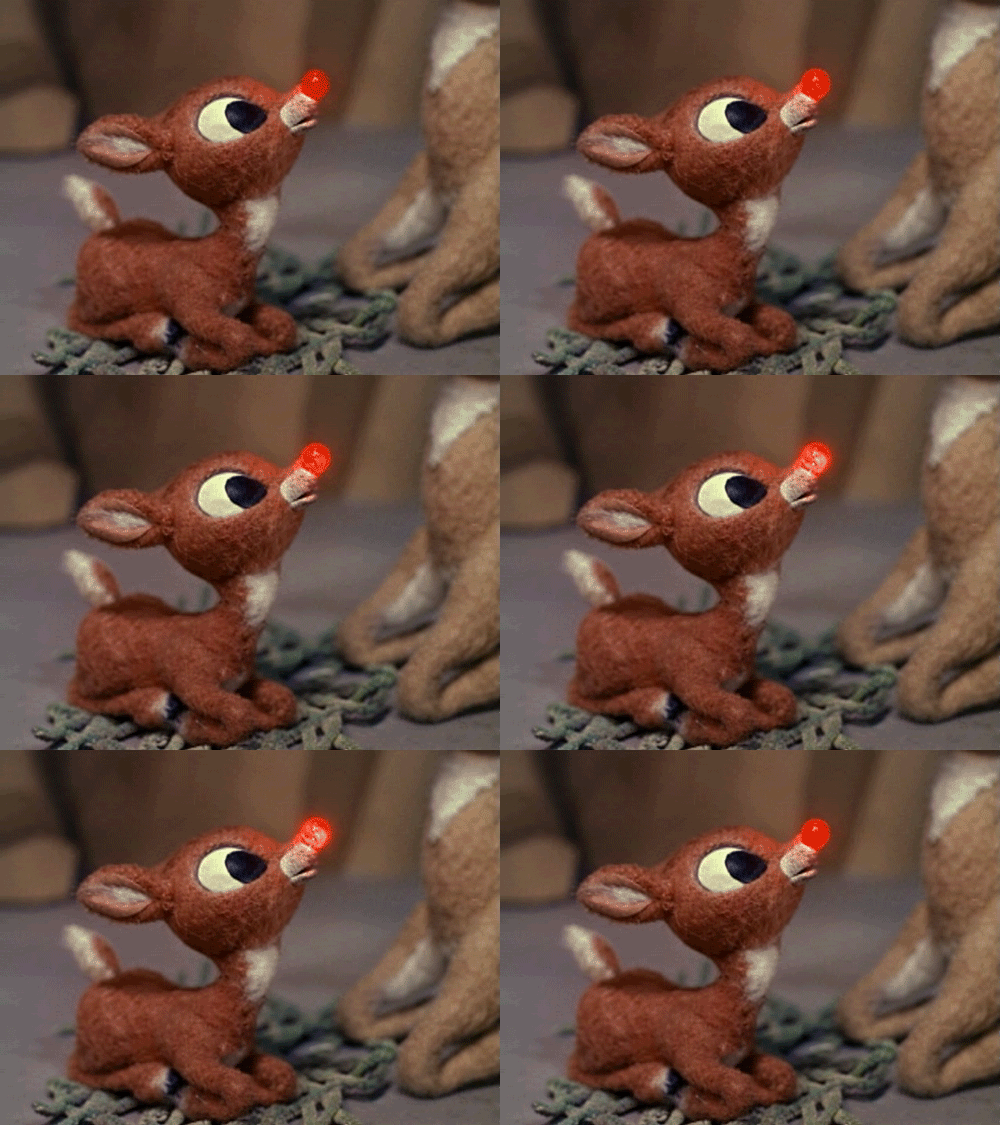
I have decided, this week, that I take issue with the story of Rudolph, a certain famed Rangifer tarandus with a scarlet nasal apparatus.

This post really should have happened closer to Christmastime.
Odds are good that you recall the song, but just in case you haven't brushed up on your Christmas carols in the three months since you last sang them, here are the pertinent lyrics.
Rudolph the Red-Nosed Reindeer
Had a very shiny nose
And if you ever saw it
You would even say it glows
And all of the other reindeer
Used to laugh and call him names
They never let poor Rudolph
Join in any reindeer games
Then one foggy Christmas Eve,
Santa came to say,
Rudolph with your nose so bright,
Won't you guide my sleigh tonight?
Then all the reindeer loved him,
And they shouted out with glee,
Rudolph the red-nose Reindeer
You'll go down in history
It's all well and good (although a little scientifically inaccurate). It's solid storytelling. We've got a relatable main character with a problem, and he's an outcast, and at the end of the story, he gets to save the day. And only he can save the day, too, because he's the only one with his peculiar ability. It has to be him. So when he uses his ability—formerly a deformity—to serve in the great purpose, he's hailed as a hero. It's cathartic.

But there's something kind of off about this song, I think. Something that vaguely bothers me. And here's what I suspect it is:

At the end of the story, Rudolph becomes useful.

Before I confess why it perturbs me, let me tell you about a flying Scot.

You would not believe how much Google Image searching I did for this.
The Flying Scotsman is Eric Liddell, the principal character in Chariots of Fire. He's a missionary kid, born to Scottish parents serving in China, and a devout Christian. He's also quicker on his feet than darn near everybody else alive at the time, apparently destined for the Olympics.

I've never seen anyone look so happy while running.
The conflict comes from his religious commitment: early in the film, his sister calls him on the carpet for missing a church service because he was training. She tells him, in no uncertain terms, that his priorities are off-base. He should be focused on the important things, like reaching the people of China for Jesus. God made him for a purpose, she says.

And Eric replies:
I believe God made me for a purpose, but he also made me fast. And when I run, I feel His pleasure.
That's awesome.

I heard this story in church a few Sundays ago, and the pastor finished by noting, "When Liddell ran in the Olympics, his event was on a Sunday. He refused to run on the Sabbath, and he became a testimony to thousands of people. Those people saw the greatness of the Gospel because of Eric Liddell's commitment to his God-given gift."

And all I could think was, No. You ruined it. 


This happened, except in my heart.
And now we've finally arrived at the point.

Recently, I've been wrestling a little bit with some questions related to Christians and art and how they interact. Specifically, how exactly does someone who wants to be both Christian and an artist get away with it?

The two terms seem a little diametrically opposed. Artists are edge-dancers: they're out exploring new ideas and asking heretical questions and looking around fearlessly for answers. Christianity—or rather, the blindly evangelical, two-dimensional, pop Christianity lots of people interact with—is a little more at home with old ideas, and traditionally accepted answers, and moving shyly away from questions.

So the Christian artist doesn't really have a home base. Neither side will claim him: the artistic community isn't interested in welcoming someone who isn't constantly exploring and innovating and pushing up against boundaries, and the Christian community...well, the conservative Christian community isn't really interested in art for art's sake. For the Christian community, there's a Big Mission, and everything has to relate to The Mission.

So the Christian artist will probably hear something more like:

"Shouldn't your art be praising God?"

Those hairstyles sure are worshipful.
That's a very interesting question. It's rooted in something good: the desire to praise God and to do what he intended. That's admirable—praising God is the end goal of mankind, if you're into the Westminster Catechism (which you should be, because it's great).

But the question is disguising something, a niggling assumption: some art does not praise God.

And that's...well, incorrect. The better word may be "incomplete."

The idea that there's a divide between art-that-glorifies-God and art-that-doesn't-glorify-God is absurd. Everything that exists is glorifying God by existing. Certainly some things can be sinful, but even sin and disaster still bring glory to God. The earth is the Lord's and so is everything inside. Christians can drink orange juice to the glory of God.

And there's another layer here. To some extent, being a Christian artist is like being a reindeer with a shiny red nose.

He's just so excited to be included!
In the story, Rudolph is an outcast because he doesn't really serve the great mission of the reindeer. And the problem I have with it is that Rudolph is only valued because he eventually served that mission.

It's the same problem I have with the wrap-up after the Eric Liddell story. It wasn't Liddell's dedication or athleticism that mattered to the pastor: it was that his decision led to more people hearing the Gospel.

But what if the story changes?

What if the foggy night never comes, and Rudolph has to come to terms with being different? Is his shiny nose still okay?

What if Eric Liddell hadn't been scheduled for a Sunday? Does God still feel pleasure when he sees Eric run?

What if you, Christian art-maker, Christian businessperson, Christian college student, Christian mother, Christian teenager, Christian whatever-you-are—you who do things, and love them, and feel God's pleasure when you do them—what if you can't ever draw an explicit line between doing the thing you love and bringing people to Jesus? What if you can never prove that you were responsible for evangelizing people because of the thing you do?

A huge number of folks feel called to make their art an evangelism tool somehow. Their songs and books and movies and cookies and carpentry are designed, somehow, with the specific purpose of bringing people to Jesus in mind. And that's great.

But the first poem in Scripture isn't about God; it's about Eve. And David composed music meant to soothe the soul without necessarily referring to God. And Solomon wrote a whole book of the Bible with no explicit, unambiguous references to Yahweh.

Maybe we can run just because we feel God's pleasure when we do it.

Maybe we can have shiny noses even if the foggy night never arrives, and we never get to prove we participated in The Mission.

And maybe The Mission's bigger than we thought at first, anyway.


For more on the subject, check out Tim Keller's talk on writing from a Christian worldview, or the Gospel Coalition's thoughts on whether art must be evangelistic to be Christian.

Wednesday, January 29, 2014

I Think We Need to Chew Our Brain-Food

I have a suspicion. An inkling, you might call it. The shadow of an idea.

I am wondering if Breaking Bad is more morally acceptable than The Little Mermaid.

Everyone in the show is bald, so no need for dinglehoppers.
In case you've been imprisoned in some distant pit for the last five years, Breaking Bad is the extremely distressing story of mild-mannered everyman, Walter White, who has the single worst midlife crisis in human history. He's laughably overqualified for his job as a disrespected high school chemistry teacher. He's working an extra job at a car wash so his family can afford to eat. His teenage son has cerebral palsy and his wife is surprise-pregnant. And, on his fiftieth birthday, he finds out he has cancer.

He really cannot catch a break.

Faced with his impending death, and certain that his family will be destitute without him to support them, he decides to make them a nest egg. Something substantial. He wants both his kids to go to college. He wants his wife to be able to live. He wants for his life not to have been a failure, and to do that he needs lots of money in a very short time.

So, as anyone would, he starts manufacturing drugs. Crystal meth, to be specific. The 61 episodes chronicle his steady descent into villainy. He engineers robberies, psychologically tortures a handful of folks, and intentionally kills/arranges the deaths of about twenty people. (He's also kind of connected to the deaths of like 170 other people, but somewhat more tenuously.)

And now for something completely different.
The Little Mermaid, on the other hand, is the extremely saccharine tale of a girl with a dream. Ariel wants to be where the people be. She wants to be different than she is. She wants to give up her life as an undersea princess to be...an oversea princess? To trade in her current life in exchange for love, in any case; she's got a serious case of the twitterpatings, and Prince Eric is just hunk enough to make her long for life on the ground.

Her father forbids it, though, probably because you can't marry a man you just met especially if you're not even the same species. Never one to take orders from fuddy-duddies, Ariel seeks out another solution: Ursula, creepy, be-cleavaged witch-queen of the sea. In exchange for her voice, Ariel receives legs and the opportunity to be a real human if she can just make Eric kiss her. She's not able to talk to him at all, but hey, that never stopped the Victorian women. (Hey-o!)

After the climactic battle, in which Ursula gets impaled with a bowsprit, Ariel's father apologizes for trying to stifle her love and she and Eric get hitched, so it's convenient she got to keep her legs.

Now here's what I'm thinking. I think—I wonder, really—if Breaking Bad is the more moral of the two. And I won't even need to dig into the Little Mermaid's subtext about how the path to true love is to shut up and let him kiss you.

Sit in your shame, Ariel. You are an embarrassment to feminism.
The thing about stories is they always have an underlying rule. English teachers might call it a theme, philosophers might call it a worldview, other folks could call it a moral—in any case, there's something the storyteller believes is true, and it's the rule that guides everything in the story. It often decides the winner; if you acknowledge and live by the Rule, you survive. If you transgress the Rule, you're probably the villain, and the story's universe might actually arrange for you to get killed.

The one basic rule in Game of Thrones/A Song of Ice and Fire, for instance, is "Adapt or die." Anyone who cannot adapt, dies. (The Rule might actually be "Don't be beloved by the audience or you will be slaughtered"—the jury's still out since the story's unfinished. For further entertainment, try this video of reactions to a particularly wham-tastic episode.)

This is all over once you start looking for it. The fundamental rule in Harry Potter is that "Love is the strongest magic of all." That's why Harry's the main character rather than Hermione; he has great love. Hermione and Dumbledore and Snape and Voldemort are all vastly cleverer than Harry is, but they're not the hero.

The Lord of the Rings? "Even the smallest of us can make a difference," as well as "Evil always corrupts." The Incredibles? "Strength through unity." The Dark Knight? "People are not like the Joker." ("You die a hero or you live long enough to see yourself become the villain" seems like a contender, except that the movie goes out of its way to disprove it—Batman stays the hero, even though he's maligned, while Harvey Dent dies the villain.)

How does this relate to Breaking Bad vs. The Little Mermaid? I'll tell you how. It's because Breaking Bad and The Little Mermaid are, loosely speaking, the same story: same drive, same protagonists, same conflict—only they have different endings and therefore different Rules. And one of them is peddling lies.

Imagine my surprise when "Breaking Bad Little Mermaid" actually returned results on Google's image search.
Both feature a protagonist who will do anything for the one(s) they love. Both protagonists give up something (or lots of somethings) in order to accomplish their goal. And both characters give an epic "Screw you!" to the establishment, seeking to be something they aren't. (A human in Ariel's case, a success in Walter's.)

But most uniquely: both characters are extraordinarily, prodigiously, mind-bogglingly selfish.

This might seem a contradiction in terms, since I said just a few sentences ago they would do anything for those they love, and love is polemically opposed to selfishness. You're right—the better way to say it is that they feel love for certain people, but their love is mostly guided by their self-interest. Ariel tries to show her love for Eric through deceiving him, as well as proving that she can do the thing she wants; Walter tries to show his love for his family through illegal moneymaking, desperate to prove to himself that he isn't a failure. They're both "loving" the objects of their affection, but in selfish ways.

At the end, the stories depart from each other. Ariel lives happily ever after, having gotten her prince and her father's apology. But Walter White's ending [SPOILER] is neither happy nor ever after; he's abandoned, alone and unloved, amongst his crowning achievements: an overblown chemistry set and millions of dollars' worth of illegal methamphetamine.

The Rule of The Little Mermaid? "Lie to your father, follow your impulses, and indulge your selfish desires: everything will turn out alright in the end."

The Rule of Breaking Bad? "Be sure your sin will find you out." It's a story about the consequences of pride. Walter White gets everything he ever chased. His name is known in every American household. He's fabulously wealthy. He's proven himself, over and over and over again, to be the very cleverest person he knows.

But his family is destroyed. His secrets are uncovered. He's ruined everything he ever touched.

He's failed.

The beard was a rousing success, though.
When I was young, my parents refused to let me watch The Little Mermaid. It wasn't because of her questionable dress sense (clamshells?); it was because they understood the thing about stories. That we consume them, and everything in them. That their Rules are always baked inside them, sometimes too deep to recognize consciously but always, always there. That stories are the most effective teacher, because they can teach us without our permission.

Stories are sneaky. Art in general is sneaky. That's half the reason why English class is required in high school. We need to be able to chew what our brain is swallowing. Art isn't meant to be a passive practice; it's an invitation to come and explore things, to listen to what someone thinks the Rule is and decide whether it's true or not.

It certainly shouldn't be an excuse to turn ourselves off for two hours. Anything becomes an opiate if you treat it the right way—we're masters at becoming numb. But what a boring life it is when we're just fat and lazy brains, gorged on food we never even tasted.

What do you think? Is the story of Walter White, narcissistic maniac, a more moral tale than that of Princess Ariel? Is a story's worldview less important than its content, or more? Sound off in the comments.

For more thinking on the subject of worldview in movies, check out this magnificent article from Christianity Today's chief film critic.

Tuesday, January 14, 2014

It's More of an Olds, As Opposed to News

Ever have that realization that you've forgotten to do something that should've been done months ago? Well, this is me doing the thing that I should've done several months ago.

I was invited (along with a friend and our instructor) to talk about writing on a local TV show called The Verbal Edge. So we went and we talked about writer's block, persistence, whether or not you can edit blank pages, and other such stuff. There's more to the episode, but I don't think it's on the Internet, and ergo it does not exist. Too bad.

On a related note, y'know what? I haven't written anything on here since last year. (Ho ho ho! Bet you haven't heard that joke done to death yet! Ain't I just the cleverest?)

Really, though, it's pathetic. I've written at least a couple posts on the importance of actually writing and recently I haven't done any of that.

Welp. There are a couple of popular euphemisms for this, but I'm pretty sure it's time to get serious or go home. Jury's out on whether it sticks this time.

Tuesday, November 5, 2013

Three Reasons Why I'm Done Dissing NaNoWriMo

Yes, that's a Viking cap being associated with pens, a laptop, and coffee.

This year, I chose to try my hand at NaNoWriMo. (This may have been a terrible decision.)

For those of you unfamiliar with the term, NaNoWriMo is the pastiched name for National Novel Writing Month. The idea, unsurprisingly, is to write an entire novel of ~50,000 words in 30 days. This works out to writing, on average, 1,667 words every day. Rain, shine, sickness, health, schoolwork, boredom: no matter the circumstance, at the end of the day, you need 1,667 words.

I don't recall for certain when I first heard of it. The earliest I can remember was seeing a status on Facebook that went something like, "Buckling down for National Novel Writing Month!" I did a bit of research, found the basic idea, and promptly concluded it was stupid.

"Hacks," I thought. "Talentless hopefuls vainly seeking self-validation so they can lord it over others." The image came into my mind, distinctly not unbidden, of someone sitting at Starbucks, curling a wispy mustache and chuckling to himself as he says, "I have written a novel, ho ho ho, and ain't I just so chuffed to have done it."

This character, whose name developed to be Humbert, would proceed to attend parties where he would say, with magnificently affected humility, "Oh, yes, I'm a novelist, wouldn't you like to hear about my novel?" and would then proceed to tell you about the novel whether you answered yes or no or by screaming.

Humbert chuckled in literature classes, speaking about Shakespeare and Tolkien and Poe as contemporaries because, of course, he'd written a novel, wouldn't you like to hear about it? 

Humbert would let no conversational opportunity go wasted: if he could redirect it to his artistic pursuits, he would do it. His favorite words were novel, writing, and me.

Humbert had no thought for editing, or for training, or for learning. Humbert writes novels. Let someone else take care of those other little chores.

Most despicable of all, Humbert had no doubt in his mind that this grotesquerie he finished over thirty days at Starbucks would be published, take the world by storm, and leave Humbert in a cozy position from which to tell us even more about his novels.


I hate Humbert—I can't emphasize that enough. I hate him for three very distinct, but interrelated, reasons.

  1. Humbert is irritating, self-obsessed, and jerkish. The most obvious reason I don't like Humbert is because Humbert is positively a goober. Humbert is a nerd about stuff he makes himself. He thinks himself an artist and is proud of it. America has a pre-existing cultural concept of the proper artist: he ought to be ashamed that he isn't doing real work. Whether we agree with that idea or not is irrelevant; the facts stand that nobody likes a conceited artist. (Content warning if you click that link.)
  2. Humbert is profaning what I perceive as my profession, or at least my desired profession. I'm spending four years and far more money than I have trying to figure out how to write things people won't hate reading. Humbert, who is a toolbag, presumes to do—on a whim, without training or preparation or any level of skill—what hundreds of geniuses have labored over for years.
  3. I am convinced that I could become Humbert if I stop thinking of how much I hate him.
Because I hate Humbert so much, I instinctively avoided the things he would do. Among those, obviously, was NaNoWriMo. My determination not to do so was bolstered from a few sources, but mostly from my satisfaction at avoiding the transformation into Humbert—or, rather, at my persistence at being a real writer. I felt confident in the assertion that real writers had no need of petty crutches like NaNoWriMo.

It wasn't until quite recently that I noticed something disheartening. As much as I hate him, Humbert is a better novel-writer than I am.

I don't mean to say that Humbert is a better writer in all respects. Odds are good that, since Humbert never lets anyone critique his stuff, I've evolved a bit more, at least in some aspects. I've got good, strong training in how to communicate; I know the difference between large-scale editing and copyediting. I know how to look at the metaplot of a story and gear it down to something rearrangeable.

But I've finished, in my time, exactly one actual "novel." (It was in tenth grade and no, no one else will ever see it, because it is shameful.) Humbert, for all his faults, has finished four, or five, or six of them in his time.

Let me be clear: Humbert's novels may not be good, but they exist, giving them one very substantial point of superiority to mine. I've started a dozen long-scale stories, and of those, finished none. I've never learned to slog through the points where the book sucks. I've never had the opportunity to edit a novel of my own because I've never made one.

So, in the spirit of humility, and also the spirit of can't-beat-em-join-em, I've signed on for NaNoWriMo. Why?

#1: Because I've proven, time and again, that I need some serious deadline threats in order to get crap done.


#3: Because NaNoWriMo's slogan is completely wrong. 

If you clicked on the link above, you might notice that the blue banner at the top says, in clean white letters, "The world needs your novel."

Gotta be honest: I think that's a load of crap. The overwhelming majority of novels written in a single month will not be things that the world needs. If anything, the world needs fewer of those. We can't be having with a constant influx of terrible stuff. Half the people doing it are working on half-baked fan-fics, for crying out loud, and the world does not need more of those. (They're a fine place to start, I'll grant, but a poor place to stay.)

I think, maybe, that the more appropriate slogan is, "You need your novel."

Nobody gets by purely on talent. No one ever got good at anything just by being born. We have to develop skill in it, and for that we need practice, and for practice, we have to love it. We have to love it enough to suck at it for a really, really long time. Enough to keep hacking away at something that doesn't feel right so that we can learn how to finish. Enough that we'll work at a grueling pace for way more than just one month on a single project that could, at the end, turn out to have been nothing except practice. 

I misunderstood NaNoWriMo for a long while. Its purpose—at least, its purpose as I understand it—is for participants to tear through something, to get a taste of the donkey-work of writing so that they have a shot at trying the donkey-work of editing. I've heard that you can't really understand your book until you've written it a few times, and for all I know it's true—I've never reached that point. There's only one way to find out, I guess.

NaNoWriMo isn't about writing a book. It's about finishing.

And I could really use some of that.

Thursday, October 31, 2013

A Dream of Smiles

Anne Elisabeth Stengl challenged bloggers to write a spooky story about a childhood fear. Happy Halloween!

The first time I saw it, I was six.

It was late. Later than I was supposed to be up. My parents had sent to bed hours ago, and I stayed up. They couldn't tell me what to do. I was my own man.

And I lay there, in the dark, not sleeping because I didn't want to, and I heard the door open with a soft click.

My parents, I assumed, were checking on me, so I closed my eyes and stirred convincingly. No sense making them angrier.

The door closed. I stayed still, figuring they would be listening for telltale sounds of movement. I was too smart for that. So I waited, and waited, and waited, until I was sure they were gone. Proud of my ruse, I rolled over to turn on my lamp, and felt my heart leap into my throat.

There was a man in my room.

Not a man, exactly. It was as tall as a man, but where its face ought to have been, there was only shadow. It wore a tall, silk hat, and when my eyes fixed on its face, a slow smile slimed its way open. Its teeth were very bright.

I wanted to scream, but it held a thin finger to its lips. I could only tell what it was doing because the finger eclipsed the gleaming of its teeth.

Someone's been bad.

I heard the words in my head, but the creature's lips did not move. It held up three fingers, and slowly curled one downward. It laid its fingers on my eyes, and I fell asleep.

*

I did not disobey my parents again after that. I went to bed on time, I followed orders, did my homework. Someone had been bad, and I wouldn't be bad again.

When I was nine, my sister and I got in an argument. She called me stupid and I called her fat, and then she said I would die alone, and so I hit her. My mother told me to go to my room, and I retreated. My palm was red where I'd hit her, and the blood pounding in my head made my anger fiercer. I could have boiled water by touching it. It felt like being on fire.

When I went to sleep, I was still angry, still throbbing with the energy of hitting something. It felt so good, I forgot what was coming.

It was midnight when I heard the door open. I woke up just enough to think my parents wanted to make certain I was sleeping, and then I heard the breathing.

Someone's been bad.

I creaked my head backward, and there it stood, with that gash of a smile in its shadowy face.

Very, very bad.

It held up two fingers, and curled one down, and then it left.

*

I've tried to live by a law since then. I never swear, cheat, steal, lie, or lust. I've never hit another person. I speak soft, when I speak at all. I'm a good boy. When the anger rises in my throat like bile, I swallow it back down. It collects in my guts, weighing in me. Better than the alternative.

I have been researching my visitor, trying to find evidence it has been seen before. There are no legends about such creatures. No one else has seen one. How could they, when there are so many bad people? It would have found them all, if it were looking at them.

But it isn't looking at them. It's looking at me.

I am writing this in hopes someone will find it, since it will probably move on soon. Find someone else to torment.

You may wonder how I know. That answer, at least, is straightforward. I say I've tried to live by a law. But I can't be perfect.

It always comes at midnight. It is 11:59, now. I suppose I haven't much time.

12:00.

Please, God.

There is a breathy sound behind me, just outside.

Please. I've been so good....

Click.

Prince of Graves

In the dark the boy walked, climbing toward the gate and wishing he were somewhere else.

The wind came, so cold he felt it touch his bones. He shivered a shiver that went all through his body, from his toes to his pitter-patter heart. He wished he had gloves, or a coat. Anything to keep warmer.

In the dark hung the moon, and it was old and lifeless, its leering eye reflected by hoarfrost and ice. The boy felt its stare in his brain, and wished he were brave, and knew it would not have mattered.

In the dark he walked, and wished he had not come.

He could see the top of the hill now, and the gate that stood there. It had five prongs, like the grasping finger bones of a long-dead giant, thrust through soft dirt. He wondered if they would curl inward when he touched them, and crush him with their deadened strength.

He scrabbled the last hundred feet and he was there, staring through the finger-bones at the silvered land beyond it. The plaque on the gate said Westminster Cemetery, but the kids in school called it Old Bill’s Graveyard.

Old Bill was William Friesen, the caretaker, and he was legend. He lived in the house at the bottom of the hill. He hated children, particularly the sort who sneaked into the cemetery late at night for dares. The stories made him out to be terrifying: seven feet tall and thin as a rake, with a face like a crocodile’s and eyes that could see in the dark. The boy doubted these were truth, but all the same he was glad that Old Bill didn’t like coming out on cold nights. It hadn’t stopped the man from leaving signs all the way up the hill: NO TRESPASSING.

The boy gripped the bars of the gate. Cold, he thought, so cold his fingers burned at the touch, but he couldn’t focus on that. The only way to stop Tommy calling him chicken was getting into Old Bill’s, and the only way into Old Bill’s was climbing the gate.

He swarmed up the bars, clambering like a spider, pushing against them with his shoes. His fingers were already blued, and his breath came harsh and sharp, but he could not stop. Relentlessly he scrabbled upward, gritting chattering teeth, until he achieved the top. The bar was thin, and he could not feel his fingers, but he balanced there for a moment, thrilled.

I made it, he thought. I made it—

His fingers faltered. He shrieked, but only briefly, as he tumbled over the gate.

*

The boy woke because someone was touching his face. His eyes opened, weakly, and he couldn’t be sure if the stars he saw were really there or merely pain-points, shunted to the front of his skull.

“You okay, kid?” said the voice. “Kid?”

The boy sat up, and the one who had woken him skittered backward like a beetle. From the new vantage point, the boy could see his leg, twisted away from him at an absurd angle. Seconds after the sight came the pain, and he sucked in a breath.

“So you aren’t okay,” said the other one, eyeing him warily. The boy did not recognize this Other One; he was skinny and pale, with wide, lamp-like eyes.

“What happened to me?” asked the boy.

“You fell,” replied the other. “Off the gate. I saw it. You slipped and your leg got all tangled up beneath you and it’s twisted weird. I saw it,” he said again. “Are you very hurt?”

“Yes,” the boy moaned. “It hurts.” But the pain was fading a little, numbing. “Who are you? What are you doing here?”

“This is my place,” said the pale one simply. “I’m Charlie, by the way. It’s not my name, except it almost is. You can call me Charlie, I mean.”

“Your place? That’s silly, it can’t be your place. It’s Old Bill’s Graveyard. Everyone knows that.”

“Old Bill?” Charlie laughed. “I know Old Bill. Old Bill knows me. We don’t like each other much. Actually that’s not true. Actually he hates me. He hates me because this is my place, not his. He can’t change that, no matter what.”

“Why is it your place?”

“It just is,” said Charlie. “What about you? Who are you?”

“I don’t think I should tell you my name,” the boy said. “You shouldn’t have told me your name, either, Charlie. Everyone knows you don’t say your name in a graveyard, or the ghosts will crawl out of the earth and swallow it up, and then you’ll never have a name again.”

“Well, you know something. But don’t worry about me. The ghosts don’t want my name. Wouldn’t do them any good, neither.”

“Why?”

“It just wouldn’t. They can’t take my name away. It’s mine.”

“Oh.”

“Will you at least tell me why you’re here? You ought to do that, since you won’t tell me your name. It’s only fair.”

“I have to spend the night here,” the boy said quietly.

“What? Spend the night?” Charlie’s eyes got big. “Why?”

“A dare,” said the boy. “It’s something the kids do around here in the summer. They tell their parents they’re sleeping over, and they sneak in here and they spend a night in Old Bill’s Graveyard. And if you don’t, then you’re chicken.”

“Seems silly,” said Charlie. “Why didn’t you do it in the summer?”

“I only just moved here. For Dad’s work.”

“Oh yeah? What’s that like?”

“I hate it,” said the boy flatly. “All of it. I hate this town, and I hate my school, and I hate my house. It’s all awful.”

“If it’s so bad, why are you doing this?”

The boy paused, and slowly said, “Rachel, I guess.”

“It’s always a girl.”

“She’s the only thing I don’t hate here. She’s so nice, and smart and pretty. She has big brown eyes and red hair. I want to grow up and marry her.” He didn’t go into detail about how much he liked her laugh, her skin, her smile. He wasn’t a wuss, after all.

“Best of luck on that one,” Charlie said in a low voice.

“She doesn’t like me, though,” he said. “She likes Tommy.”

“Ah. Tommy, eh? I’ll bet he’s impressive, ain’t he?”

“Not really,” the boy said. “I sure don’t see why she would like him.”

“’Course not.” Charlie looked thoughtful. “This Tommy kid. What’s he look like?”

“Big. He’s as tall as Martha Ann, and she’s two whole years older than us.”

“Dark hair, blue eyes? Sort of look like a dog that figured out how to walk upright?”

“That’s him! How’d you know?”

Charlie laughed harshly. “’Cos I seen him. He came to my place a few years ago. But I’ll tell you a secret, seeing as how we’re friends and all: he didn’t stay all night. He got scared. He snuck out.”

The boy’s face lit up. “No!”

“Oh, he did. He did. He couldn’t see me, but I was there.”

“How’d he get out?”

“There’s a door in the wall, near the back,” Charlie said. “Old Bill doesn’t know about it. It’s as the hill goes down so it gets all covered in snow and nonsense, you know, so it’s hard to find. This Tommy boy, I remember him. He came here one day with his big brother. Did some exploring, adventuring, he found that little door and next week he comes here in the night. Bet you anything he started that dare thing you’re doing.”

“You’re lying.”

“Am not. I’ll show it to you. Come on. Your leg getting better? I bet you can walk on it now.”

Charlie was right; the boy’s leg didn’t hurt near as much as it had. All he could feel in it was a sort of dull ache, numbed by the cold. He felt uneasy about that, but the uneasiness was nothing compared to the excitement at the thought of the door. He could go home, could get warm, and he would have something over Tommy. What would happen if he told all the other kids that Tommy had chickened? Maybe Rachel would stop liking him….

Charlie grinned at the boy’s mounting excitement and held out a hand. “Good then. Come on, kid, I’ll show you. You can lean on me.”

The boy took Charlie’s hand, and Charlie pulled him to his feet. They leaned on each other, the nameless boy favoring his weirdly twisted leg, and Charlie led them to the back of the graveyard, navigating around snow-encrusted tombstones.

“What do you mean this is your place?” the boy asked again. “How did it become your place?”

“It’s just mine, that’s all,” Charlie replied. “You stay somewhere long enough, eventually it becomes yours.”

“You stay here? How long have you been here?”

“I don’t know. A while, I guess. Since I left.”

“But how did you get here? Why doesn’t Old Bill kick you out?”

“He can’t. He can’t do nothing to me. Told you, didn’t I? This is my place. Not even Bill can throw me out if it’s my place. Nobody can.”

“I wish it was that way with me,” the boy said. “Then we wouldn’t have had to come to this stupid town.”

“Grown-ups.” Charlie sneered. “They’ve got no respect for us. They don’t ever care for anybody but themselves, kid, and don’t you ever forget it. That’s why I’m here, you know? That’s why I made this my place. My papa didn’t care for no one but himself, so I just . . . you know, I left.”

“You live here alone?”

“Not alone,” Charlie said. “Not all the time.” His voice was low and final, and the boy could tell Charlie didn’t want to answer the obvious question.

They hobbled in silence for a minute, until Charlie said, “Here it is.”

Charlie pushed aside a mound of old snow to reveal a door built into the wall. It was painted gray, and covered in intricate designs that reminded the boy of spider-webs. There seemed to be a pattern to them, but he couldn’t quite find it: following one strand inevitably led to following another, and another, and another, until he couldn’t tell where he’d started or how long he’d been looking.

“This’ll take me out?” he asked.

“Right in one,” said Charlie. “You’ll be all set.”

As he spoke, they heard a high screeching of iron against iron. They turned to the gate, and the boy’s heart stopped.

“Old Bill,” he said.

“Hurry,” said Charlie. “Hurry, get the door open. He can’t punish you if he can’t catch you.”

The boy grasped the metal handle and yanked with all his might. The door was barely taller than him, and should have opened easily, but it was fused to the wall with ice and rust. He yanked harder.

“You!” shouted a harsh voice. Old Bill had pushed past the rotted old gates and was stampeding through the graveyard, hair trailing behind him, fiery white—

“Hurry!” Charlie urged. “Hurry! You got to!”

“Don’t open that door!”

The boy gritted his teeth and pulled in desperation, frenzied. His lip must have gotten caught in between his teeth—rivulets of blood were trickling down his chin—

The door gave way. He tumbled through it, moving awkwardly on his bad leg but feeling no pain in it. He cast a glance over his shoulder to pale-eyed Charlie, who stood at the door with an eerie grin.

“Are you coming?” asked the boy.

“Nah,” said Charlie, still with that narrow smile. “You go on ahead. He can’t hurt me. Bye, kid. Thanks.”

And he slammed the door closed before the boy could even ask, For what?

*

William Friesen carried the boy out himself, hefting him effortlessly, like a sack of potatoes. He carried him all the way down the hill, to his lonely little shack, and wrapped him in blankets before calling 911. His teeth chattered and he missed the numbers twice before he managed to get the line active. The girl on the other end sounded youngish, and very serious.

“What is your emergency?”

“A boy,” Old Bill stammered. “Erm, young boy. Sneaked into the cemetery. He’s hyper…hypo…he’s cold. Colder’n he ought to be.”

“Where are you, sir?”

He told her, and went on, “You need to hurry.” He hung up.

The boy was shivering beneath the blankets. Old Bill sat beside him, thinking he ought to pray, knowing it would not matter. He did so anyway, babbling out words his grandmother had taught him, words they used to say before science made the world a simple place. He didn’t remember what they meant. Only what they were meant for.

The ambulance arrived quickly, lights flashing, eager medics stampeding all over Bill’s home. They wheeled the boy away on a stretcher, and Old Bill followed, chewing his lip to ragged bits.

Before they pushed the boy inside the ambulance, his eyes opened. Moonlight shone in them, made them milky. They roved, briefly, before landing on William Friesen.

“You saved me,” he murmured, speaking past a leaden tongue. “Thank you, Mr. Friesen.”

The paramedic beside him checked his pulse, moving with old-hand efficiency, and signaled a discreet thumbs-up to the caretaker, mouthing, he’ll be okay. He turned to the shivering child. “How are you feeling, kid?”

“Good,” the boy muttered. His eyes were still fixed on Old Bill, and they shone, lamp-like. “Really good. I feel like it’s my place.”

Saturday, August 10, 2013

I Must Not Be Batman

You know what's really cool? We're gonna talk about deontology vs. utilitarianism in terms of superheroes, and you're going to understand
Aren't comics awesome?!

For those of you who don't notice the logos that precede the blockbuster movies you've been watching recently, in the world of comic book superheroes, there are two giants: Marvel and DC. Now, upfront, I'll cop to being a Marvel fan more than anything else. Spider-man is my spirit animal and I've never really connected with any of the characters in the DC Universe.

There is, however, a reason for that. You see, Marvel makes characters, and sometimes they make heroes. We can connect to them because they're flawed, and human, and they're often losers. But DC is different. DC makes ideas.

Hang with me on this. We'll start with Superman.

And I love you, Random Citizen! *

*Not actually Superman quote.

Superman is maybe the most famous superhero on the face of the planet. In case you haven't left the shelter of your rock since 1938, he's an alien who escaped to Kansas when his home planet exploded, leaving him the last of his race. It's fortunate there's only one of him, because Superman is terrifying. Superman is a physical god. He's faster, stronger, and more resilient than anything Earth has ever managed to crank out. Compounding that, according to All-Star Superman, his brain is super, too. He can see wavelengths humans might not even know about, and his mind operates at a swifter pace. Basically, he wins at everything, always.

On a story theory level, this is a serious problem, because people rarely take an interest in god-level characters. God-men don't struggle, and stories without struggle aren't interesting. So the problem the writers of Superman are faced with is how to make Superman somebody worth reading about. Clearly they succeeded—if they hadn't, we wouldn't be churning out movies, cartoons, and songs (and songs, and songs, and songs) about the guy. And Bill (the guy who gets killedwouldn't spend three solid minutes talking about him.

The trick is that Superman's struggle is all to do with his monumental choice. Given what power he has, he has to decide whether to save the world or destroy it. He's a giant walking among ants. He can do whatever he wants. So he decides he wants to save it. (Check out this video for a much more detailed look at this aspect of his character.)

Of course, the thing about being a giant is that you have to be very, very careful where you step. So Superman is always following his own unbreakable code of ethics. He doesn't lie, cheat, steal, or play dirty at any step of the game. He's a dyed-in-the-wool Boy Scout.

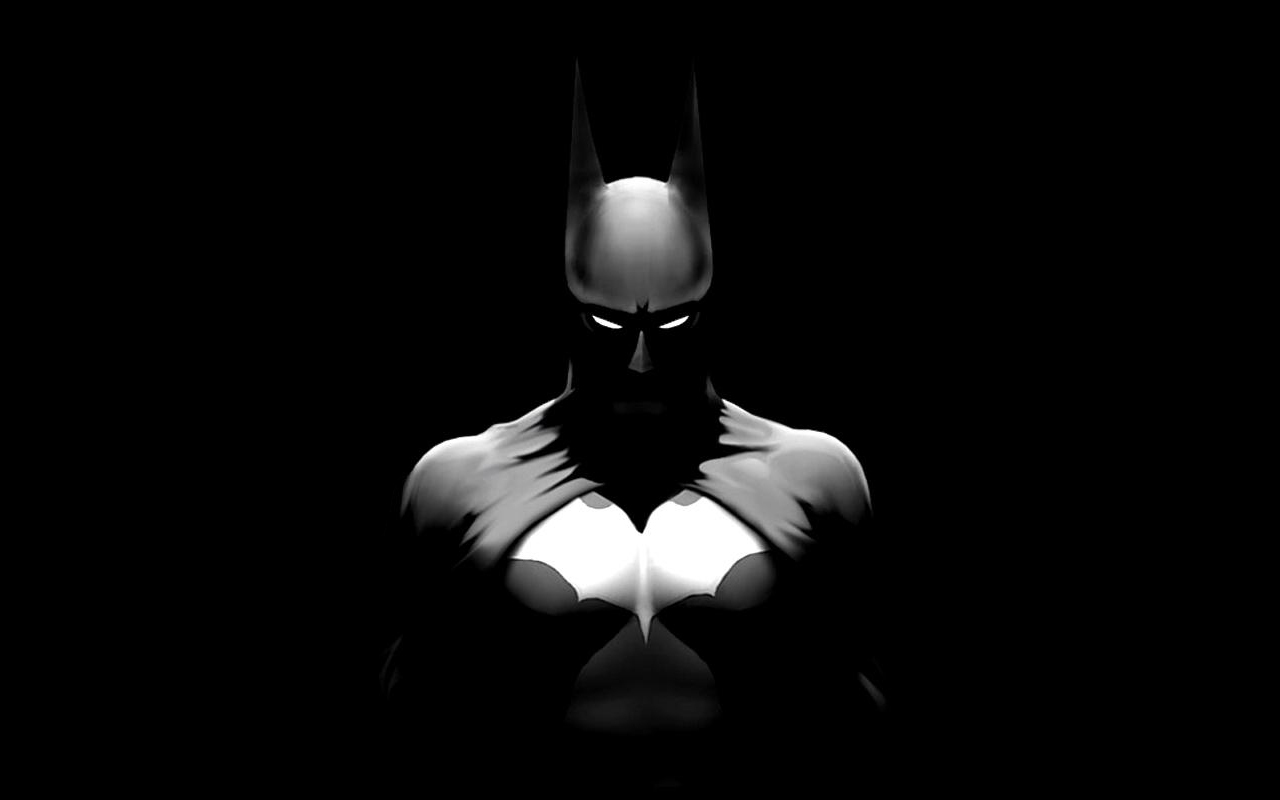
Batman could not be more different.

Taking a fiercely contested second place to Superman for most-recognized-superhero, Batman makes up for it by being, perhaps, the most butt-kicking. In direct contrast to Superman (who has ALL the powers) Batsy has no superpowers at all (except his budget). He's a master fighter, a spectacular detective, and generally a terrifying ninja. But he does it without any supernatural powers. Where Superman is godlike, Batman is wholly human.

To make up for his lack, though, Batman has no limits. He has exactly one rule ("Thou shalt not kill") that he won't break, but short of that, anything and everything is fair game. He will do whatever it takes to stop the bad guys, from psychological warfare to breaking bones to spying on an entire city. From his perspective, these are necessary—he has nothing else to fall back on. Superman can afford to be a Boy Scout because he has enough power to back it up. Batman doesn't, and therefore can't.

Loosely speaking, Batman embodies a utilitarian ethic ("the end justifies the means"), while Supes personifies a deontological one ("the means justify the end"). This delineation defines almost every aspect of their personalities. Superman is associated with truth and justice, while Batman is known as the Dark Knight. Superman is polite, well-intentioned, and cautious. Batman is gruff and he will slam your face into a table.

He is the night, and he does not have time for your nonsense.

You can learn a lot about a culture by looking at the heroes they immortalize in stories. Greece had Odysseus, Rome had Julius Caesar, France has...erm...I'll go with Jean Claude van Damme. And America has Superman, Batman, and all the characters falling in between.

For a long while, Superman was considered our biggest cultural icon. He was the principal figure of the Golden Age of Comics, when men were men, übermensch were übermensch, and women were just...sort of...there. (Because there had to be some diversity, right?)

The Golden Age of Comics, though, eventually gave way to the Modern Age (where we are now). In the Golden Age and most of its successors, comics leaned Superman-wardly, because America thought of Supes as our avatar in fiction. Like Superman, we were powerful and responsible. We needed to be careful where we stepped. Most of all, we were required to be righteous—to do the right thing, no matter what it cost in the long run.

But in the Modern Age, that zeitgeist has vanished. Comics have shifted away from Superman's rosy perspective to the grittier world of the Dark Knight. The 80's saw the deconstruction of the superhero-as-a-nice-guy. Now we have Jack Bauer, Gregory House M.D., Ozymandias and Rorschach, and the Doctor. We've crawled sneakily away from the shiny ethics of Clark Kent to the far more frightening, far more efficient world of Bruce Wayne. We care more about competence than compassion.

This isn't just evident in our stories, or in our politics (looking at you, U.S. government). Look closely enough and you'll see it everywhere. The temptation is to buy into Batman's worldview, because, let's face it, Batman gets the job done. He does the only thing that makes sense. His world doesn't have rules, and even if it did, there's no one to back them up—except him. He does what's necessary because no one else can. Compassion is well and good, but he'll take competence every time.

I worry that sometimes I tend to think that way, too.

I'm the guy on the left.

For a long while, I've had a serious issue accepting the Christian subculture, because for the most part, it is just that: sub-cultural. Our attempts at making art are generally not very good. (I'm looking at you, Facing the Giants. And you, Fireproof. And you, Family Christian Bookstore.) Our church services can often really suck. So, too, can our church communities. As a widespread rule, I did not find the church able. They weren't competent. They had a job to do and they were failing to do it.

I couldn't forgive that.

I've been confronted, though, with the fact that God does not go looking for competence. In fact, "competence" is somewhere near the bottom of the list of divine qualifiers. If memory serves, God picked someone for competence once. Once. (It's in 1 Samuel. The candidate is good-looking, a powerful warrior, a compelling speaker. He's the king Batman would choose. He tanked the job so bad that God picked his successor halfway through his reign. Nothing like meeting your replacement, especially when he's a scrawny, metrosexual, seventeen-year-old shepherd with a thing for the harp.)

Missionary to the Gentiles? Started out as a religious persecutor. Apostles? Mostly uneducated fishermen, plus a slimy money launderer and a terrorist. Best-known Jewish king in history? Promoted from "sheep-herder boy." Savior of the human race? Born amongst pigs and cattle, to a disgraced 16-and-Pregnant mother and a seemingly-cuckolded carpenter, in a backwoods town in a downtrodden nation of failures and former slaves.

God does not pick based on competence. It's not His style.

With this in mind, I'm making a resolution: I must not try to be Batman any more.

Let competence live and die on its own.
Let the Christian cool factor fluctuate.
Let my instinct to be awesome—to do awesome things that would make God proud of me—starve to death.

So Christians really suck at making movies/music/what-have-you. Our competence isn't what saves the world.

That's Jesus' job.

Time to leave it to Superman.

Thursday, May 2, 2013

So What Is a Writer, Really?


What is a writer?

Are you ready for this? I'm going to blow your mind.

A writer is one who writes.

Take note of the present tense, as it is the most important part of that definition.


I think most aspiring writers have adopted the mindset that "writer" is an adjective written on our hearts from the day we were born. It means deep thinker, and storyteller, and wordsmith. It almost always means lover of books, and words, and ideas. It can mean poet or newsman or novelist. In popular thought it rarely coincides with "mathematician" or even "able to add things." But we view it as irrevocably and undeniably a part of who we are. Whatever else may happen, our identity is firmly lodged in two things: "I am human," and "I am writer." Nothing removes that.

This, I think, is wrong.

One who writes. That's it. That's all there is to that definition. It doesn't have to mean published. It doesn't even have to mean good. But it connotes a necessity of persistence.


A writer is not "one who wrote while in high school, but recently has been focusing on other projects." A writer is not "one who got good grades in English class and has a brilliant idea for a book." A writer is not "one who dreams wistfully of becoming J.K. Rowling/J.R.R. Tolkien/C.S. Lewis/K.A. Applegate/Robert Heinlein/Patrick Rothfuss/what-have-you."

It can have those things. But they're all useless to you unless you're doing. Wanting to write, having written, trained in writing—these are all good things. Wrote a novel once. Have a great idea for a book. Love writing.

Those are excellent, in fact. But they are useless to us unless we are writing.

Someone who claims to be an athlete but never sets foot in a gym is not an athlete. A carpenter who never touches wood is not a carpenter. A practitioner who doesn't practice is a liar or a fool. The practice—doing the thing—is built into the word.

You may feel that writing is a thing etched into your soul. I wouldn't be surprised if it is. Communication is one of the great human purposes. It's how we brush up against the soul of other humans.

But what use is a thing in your soul if you never pour it out through your hands?

*

I must be honest with you: I'm dogmatic on this because I can't afford not to be.

By my own stringent definition, I've not been a dedicated writer for three months. When I wrote the 64-Day Hypocrite, I fully intended to get back to writing. To get back in touch with the wild thrill of making things up and writing them down. And, to an extent, I have. But not yet to the same degree I had in January. It's hard to gain the momentum back. I know it's possible. I just haven't had the requisite willpower to do it, and now school has fallen on me like a granite block and I can't wriggle out long enough to scribble a single meaningful sentence. All my creative energies go toward school and people. Even this blog post is an assignment.

So, in a sense, I have an excuse, and that's the most dangerous place in the world.

I can't afford to have excuses for very long. Even less can I permit myself to buy into the idea that we're defined as writers by our passions instead of where our passions drive us. If I shift the definition of the word so that it will always include me, no matter what I do with my time, then I have no need for relentless creativity. I'm still a "writer" if I lay in bed all day and do nothing. I'm still a "writer" when I while away my hours on video games. In short, folks, I would have no need to DO anything.

That's what matters, really. It's not what you are. It's what you do. It's where your time goes. It's where your passions lead you. You can make claims all you like, the way I've done for so many years—being a hobbyist writer talking about how awesome things were going to be when I finished the writing that I wasn't really doing, instead of a dedicated and purposeful maker. That's the difference. That's the knife edge separating fulfillment and bitterness: while self-important hobbyists wax eloquent of the things they'll do when they have the time, the ones who care enough to succeed are busy doing it.

What are your thoughts, reader? What is a writer, really?